top of page

The following are photos taken at Aysha Memorial Hospital on the last day of clinical practice of the Spring 2016 semester for the students in NUR219. These are second year students and the NUR219 class is the first time that students attend clinical practice. Prior to this experience, the students are in the lab classes on campus.


20160413_082631

On the left is Shuvashish Das Bala, the instructor for NUR219. It was Shuvashish’s first time in this role as Assistant Lecturer at IUBAT University, taking students on clinical.  This is significant as to highlight the importance of the volunteer faculty (in this case, Roslyn) to help support these new and eager faculty members transition into this role. Next to Shuvashish (from left to right) are nursing students Philomena, Khadiza, Roslyn (volunteer faculty) and Sumona.


20160413_082533

In this photo is Mohammad Ali (Kiron), Assistant Lecturer at IUBAT University, with Philomena, Khadiza, Roslyn and Sumona. Whilst not responsible for this class, Kiron participated with clinical to gain experience in this role and to prepare himself for when he will be responsible for taking his students on clinical placement.  
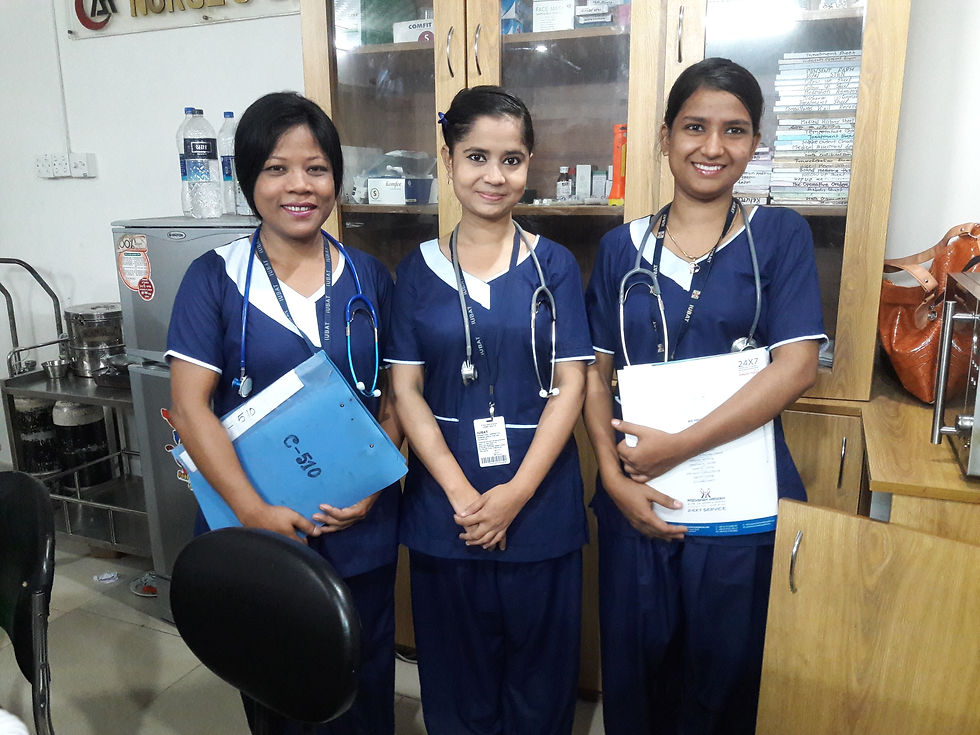

20160406_084016

Nursing students, Philomena, Sumona and Khadiza are illustrating standard dress while on clinical. Students are expected to be neat, professional and in uniform, and ready to participate in any and every experience while on practical. They are expected to take notes, ask questions and learn as much as possible. The teachers supervising are available to help and ensure that international standards being taught at IUBAT University are being upheld in the clinical environment.


20160406_095923

Finally, this photo showcases nursing student, Sumona, at Aysha Memorial Hospital on the female ward at the nursing station, reading a patient’s chart.

In this course, students attend the hospital one day/week for clinical practice and according to volunteer faculty, Roslyn, “it was really great to see how excited and eager the students were. They would come to the teachers with charts to show us patients on the wards that had conditions related to what they had been learning in lectures. They would describe skills they had participated in with the nurses on the wards, follow doctors on rounds, tend to patient care and translate to English for the foreign faculty what they were discussing/asking patients. The students improved greatly over the semester and it was a pleasure to see them grow in their skills and confidence as student nurses.”


A huge thank you to Roslyn Coltheart who helped with the descriptions of the photos and elaborating on this course during the nursing curriculum.  


Please visit our Flickr page for more photos!


IMG_7369-pp (1)

Mohammad (Kiron) Ali is currently a faculty member at IUBAT, teaching students at the very same school where he learned to become a nurse himself.  When asked how he came into nursing and about his future vocational goals, Ali shares some wonderful news with our readers.  


He writes: “Greetings from Bangladesh! I am very sorry for the late reply, as you can imagine how busy we are during the semester end at IUBAT. I came into nursing in 2007, a couple of months after successfully finishing the Higher School Certificate examination.  The decision I made to study nursing was against my family’s wishes.  Historically, nursing is locally viewed as a poor profession and dirty job.  Consequently, I faced discrimination and criticism from my family, friends, and neighbours.  In my youth, I had never dreamed of becoming a nurse, nor did I know what nursing truly entailed.  While I was studying in higher secondary school, I had a growing interest to enter the medical profession.  Fortunately, I had the opportunity to talk with Prof. Dr. Karen Lund, former Chair, College of Nursing at IUBAT.  She gave me full insight and knowledge about the nursing profession, and I applied for admission that same day.


Presently, I am working very hard for the residency permit (RP), which takes a lot of paperwork.  I’m happy to share the news to all of my well-wishers, nationally and internationally, after getting RP, and a scholarship!  I have been accepted to the Master’s of International Health program at Uppsala University, in Uppsala, Sweden.  The program will last two years and begins on August 29th, 2016.  Furthermore, the scholarship I have been awarded is called the Swedish Institute Study Scholarship (SISS), bestowed upon me by the Swedish Institute, a public agency whose commitment is to gain knowledge and understanding of different cultures, their people, and to promote Sweden and Swedish issues globally.   Here is more information about the scholarship and the Swedish Institute: SISS – Application procedure and key dates: Swedish Institute.


For my accomplishments in my career thus far, I would like to thank three special people in my life.  Prof. Dr. M Alimullan Miyan, Vice Chancellor of IUBAT, for giving me the opportunity to study at this university under the umbrella of the Knowledge-Based Area Development program (KBAD).  Secondly, Prof. Dr. Karen Lund has been the biggest motivator in my life.  Finally, Prof. Alex Berland, Senior International Adviser of College of Nursing, who has been my mentor.  I will continue writing with follow-ups and updates.  I deeply acknowledge the efforts of all those I mentioned and hope for a continued strong Bangla-Canadian relationship.”


We’re grateful for the update and even happier to hear the great news, Kiron.  All the best to you at the end of a busy semester of instruction, and for your two-year Master’s program in Uppsala!  Perhaps we will hear more about your international adventures further into your career.


orientation 2

A recent volunteer, Roslyn Coltheart, answered some questions to allow us to share her experiences as a visitor to Bangladesh and a staff mentor at IUBAT.  Roslyn held a unique volunteer position as she was not an instructor to the nursing students, but rather, a mentor to new permanent faculty at IUBAT.  She is pictured above with faculty members and students at the 71st orientation program for new students (“Fresher”), for spring semester.  In the picture from left to right: Faisal (nursing student), Roslyn, Tutal (IUBAT graduate and now faculty), Khadizia (IUBAT faculty, graduate of armed forces medical college and the first non-IUBAT trained staff), Tahamina (IUBAT graduate and now faculty), Tithi (nursing student), Shoykit (nursing student), Shuvashish (IUBAT graduate and now faculty), and Elma (nursing student).


What were your roles/responsibilities in Bangladesh and when did you become involved with the Bangladesh Health Project?


“I first came across the Bangladesh Health Project in 2013, when I read an article in the American Journal of Nursing. At the time, I had just moved from Australia to Canada but filed the information away for future reference. In early 2015, I applied to volunteer with the Project. Initially hopeful to be there for the September to December 2015 semester, I had to delay due to Canadian immigration difficulties and arrived January 7th 2016, staying until April 16 2016, during spring semester. 


At this time in the Project, six IUBAT graduates had been hired as teachers and I was the first volunteer to join the project, not as a teacher myself but as a mentor for these young teachers. My roles and responsibilities were very autonomous and self directed. My main focus was not to teach, but to help guide the teachers to develop their confidence, teaching styles, assignment setting, exam marking etc. I would sit with teachers before class and help them prepare, join classes and give support, answer questions, join in discussions, read assignments and give feedback on marking. I also accompanied teachers and students to attend clinical placements and updated some old lectures. 


As I was not directly responsible for classes each week, I had more flexibility to travel some parts of Bangladesh whilst there.”


What/where is your current position/role (i.e. are you a practicing nurse, writing/teaching full time?)?


I am an Australian registered nurse and have now been living and working in Canada for 3 years. I graduated in 2004 and have predominantly worked in Emergency in that time frame. I am currently registered in BC and working in Emergency.


Can you share your overall impressions of Bangladesh and your experiences with the Project?


“I had a truly great experience in Bangladesh, I can’t believe the availability of so many different foods! I’m very happy I came across the Project and was able to experience it. I am also happy I came across it in the stage that it was at: during the transition of the graduates into lecturers, rather than as a teacher myself. I found the role interesting, challenging, stimulating and worthwhile, although I had a few challenges along the way! All of the teachers said I made a difference, but a mentee faculty member probably gave me the greatest insight into this when he said something along the lines of, “You may not realize the difference you have made, but we know.” It was also interesting to hear the students talk at the end about things they had learned from having me there – a few off the cuff remarks I made seemed to have made an impact! I have encouraged them all to keep in contact and they are aware I’m happy to help over email when and if they need it.”


Thank you for sharing your insight during a pivotal time during the Project’s development, Roslyn, and it is without doubt that your assistance and guidance has helped strengthen the foundation and shaped the growth of the nursing program at IUBAT.  We’re sure the students and faculty alike can wholeheartedly agree that your influence has been positive and beneficial for the future direction of the Bangladesh Health Project!


STRENGTHENING POPULATION HEALTH IN BANGLADESH

  • alt.text.label.Facebook
  • Flickr
  • alt.text.label.Twitter

Subscribe to our newsletter • Don’t miss out!

Thanks for subscribing!

©2022 by Bangladesh Health Project.

bottom of page